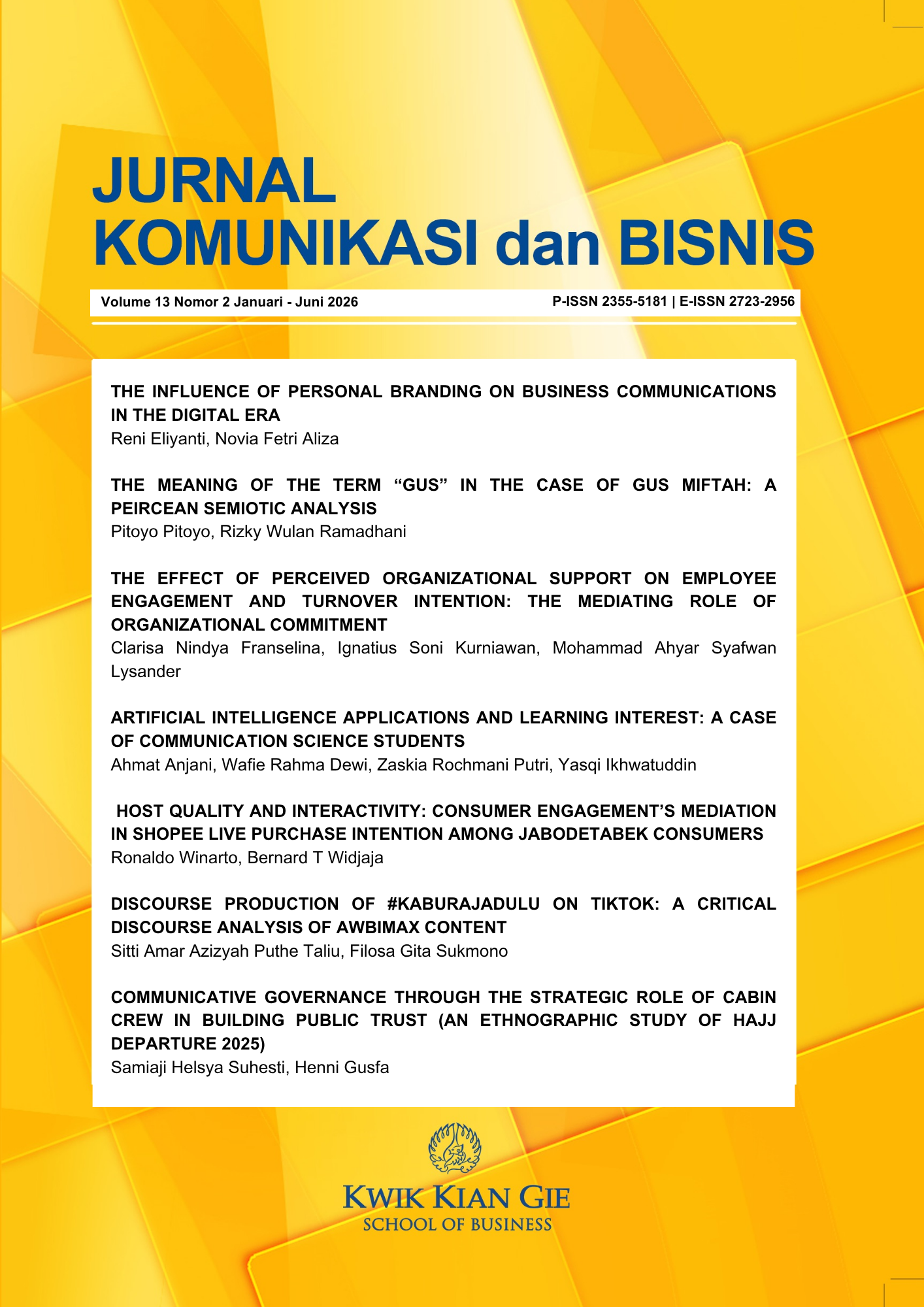
Artificial Intelligence Applications and Learning Interest: A Case of Communication Science Students
 Ahmat Anjani
Published 2026-01-13
Keywords
- artificial intelligence application,
- learning interest,
- communication science students
How to Cite
Copyright (c) 2026 Jurnal Komunikasi dan Bisnis

This work is licensed under a Creative Commons Attribution-NonCommercial-ShareAlike 4.0 International License.
Abstract
The increasing use of Artificial Intelligence (AI) in higher education has brought notable changes to the way learning activities are designed and experienced, particularly through more interactive and individualized learning approaches. From a theoretical standpoint, AI-supported learning environments are assumed to foster greater student engagement and stimulate interest in the learning process. This study aims to investigate the influence of AI application usage on the learning interest of Communication Science students at a private university in Bandung. A quantitative research approach with an explanatory survey design was applied in this study. Data were obtained from 97 students through a structured online questionnaire and analyzed using simple linear regression techniques. The results show that AI application usage has a positive and statistically significant effect on students’ learning interest. Students who engage more frequently with AI-based tools tend to demonstrate higher levels of attention, enthusiasm, and inclination toward learning activities supported by AI. From a theoretical perspective, these findings contribute to the body of knowledge on technology-enhanced learning by reinforcing the role of AI in shaping students’ learning interests. From a practical perspective, the findings indicate that the thoughtful integration of AI-based tools into instructional practices can enhance student engagement and motivation to learn.
Downloads
References
- Alowais, S. A., Alghamdi, S. S., Alsuhebany, N., et al. (2023). Revolutionizing healthcare: The role of artificial intelligence in clinical practice. BMC Medical Education, 23, 689. https://doi.org/10.1186/s12909-023-04698-z
- Baidoo-Anu, D., & Ansah, L. O. (2023). Education in the era of generative artificial intelligence (AI): Understanding the potential benefits of ChatGPT in promoting teaching and learning. SSRN Electronic Journal, 7(1), 52-62. https://doi.org/10.2139/ssrn.4337484
- Balog, M. M., & Demidova, S. E. (2021). Human capital development in the context of the fourth industrial revolution. IOP Conference Series: Earth and Environmental Science, 666, 062120. https://doi.org/10.1088/1755-1315/666/6/062120
- Cotton, D. R. E., Cotton, P. A., & Shipway, J. (2023). Chatting and cheating: Ensuring academic integrity in the era of ChatGPT. Innovations in Education and Teaching International, 61(2), 228–239. https://doi.org/10.1080/14703297.2023.2190148
- Davis, F. D. (1989). Perceived usefulness, perceived ease of use, and user acceptance of information technology. MIS Quarterly, 13(3), 319–340.
- Eriana, E. S., & Zein, A. (2023). Artificial intelligence (AI). Eureka Media Aksara.
- Falloon, G. (2011). Making the Connection: Moore’s Theory of Transactional Distance and Its Relevance to the Use of a Virtual Classroom in Postgraduate Online Teacher Education. Journal of Research on Technology in Education, 43(3), 187–209. https://doi.org/10.1080/15391523.2011.10782569
- Fredricks, J. A., Blumenfeld, P. C., & Paris, A. H. (2004). School Engagement: Potential of the Concept, State of the Evidence. Review of Educational Research, 74(1), 59-109. https://doi.org/10.3102/00346543074001059
- Handayani, R., Annis, A., Asminanti, A., Nisya, K., & Ikhsan, A. N. (2025). Peran teknologi dalam meningkatkan kualitas pendidikan. JARIAH: Jurnal Risalah Addariya, 62–72. http://e-journal.staisddimangkoso.ac.id
- Hidi, S., & Renninger, K. A. (2006). The Four-Phase Model of Interest Development. Educational Psychologist, 41(2), 111–127. https://doi.org/10.1207/s15326985ep4102_4
- Holmes, W., Bialik, M., & Fadel, C. (2019). Artificial intelligence in education: Promises and implications for teaching and learning. Center for Curriculum Redesign.
- Masdar, A. K. C., Nadira, L., Murnika, Y., & Wismanto. (2024). Pemilihan media pembelajaran yang tepat untuk meningkatkan hasil pencapaian belajar peserta didik. Edukasi Elita: Jurnal Inovasi Pendidikan, 1(3), 76–85. https://doi.org/10.62383/edukasi.v1i3.243
- Mayer, R. E. (2009). PRINCIPLES FOR FOSTERING GENERATIVE PROCESSING IN MULTIMEDIA LEARNING. In Multimedia Learning (pp. 221–222). chapter, Cambridge: Cambridge University Press.
- Muchminiin, M. A., Rahmadhani, M. K. A., Muqorobin, S., Mustaghfirullah, F., & Luthfi, O. S. (2024). Pengaruh penggunaan artificial intelligence (AI) terhadap minat belajar mahasiswa. Mars: Jurnal Teknik Mesin, Industri, Elektro, dan Ilmu Komputer, 2(4), 56–62. https://doi.org/10.61132/mars.v2i4.235
- Nguyen, A., Ngo, H., Hong, Y., Dang, B., & Nguyen, B.-P. T. (2022). Ethical principles for artificial intelligence in education. Education and Information Technologies, 28, 4221–4241. https://doi.org/10.1007/s10639-022-11316-w
- Nurhasanah, S., & Sobandi, A. (2016). Minat belajar sebagai determinan hasil belajar siswa. Jurnal Pendidikan Manajemen, 1(1), 128–135. https://doi.org/10.17509/jpm.v1i1.3264
- Ryan, R. M., & Deci, E. L. (2000). Intrinsic and extrinsic motivations: Classic definitions and new directions. Contemporary Educational Psychology, 25(1), 54–67. https://doi.org/10.1006/ceps.1999.1020
- Salsabila, U. H., Putri, V. A., Cahyani, P., Annisa, A., & Yuliatin, A. T. (2021). Upaya dalam memajukan teknologi pendidikan Indonesia. Nusantara: Jurnal Pendidikan dan Ilmu Sosial, 3(3), 442–458. https://ejournal.stitpn.ac.id/index.php/nusantara
- Seo, K., Tang, J., Roll, I., Fels, S. S., & Yoon, D. (2021). The impact of artificial intelligence on learner–instructor interaction in online learning. International Journal of Educational Technology in Higher Education, 18. 54. https://doi.org/10.1186/s41239-021-00292-9
- Sullivan, M., Kelly, A., & McLaughlan, P. (2023). ChatGPT in higher education: Considerations for academic integrity and student learning. Journal of Applied Learning & Teaching, 6(1). 31-40. https://doi.org/10.37074/jalt.2023.6.1.17
- Zawacki-Richter, O., Marín, V. I., Bond, M., & Gouverneur, F. (2019). Systematic review of research on artificial intelligence applications in higher education: Where are the educators? International Journal of Educational Technology in Higher Education, 16, 39. https://doi.org/10.1186/s41239-019-0171-0