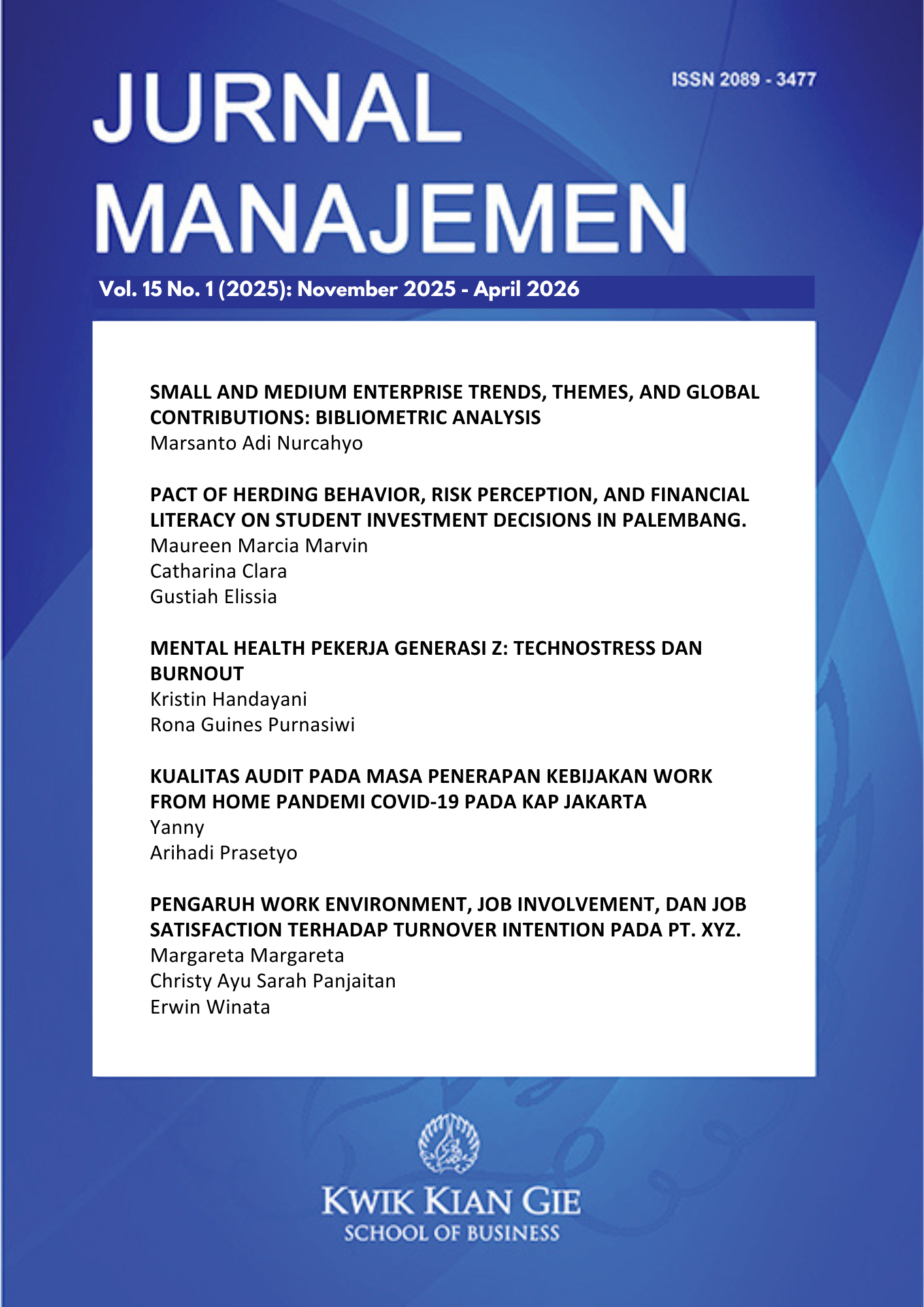
Pengaruh work environment, job involvement, dan job satisfaction terhadap turnover intention pada PT. XYZ
Article Sidebar
Main Article Content
Abstract
This paper seeks to analyze how work environment, job involvement, and job satisfaction influence turnover intention at PT. XYZ. The study involved 119 employees as respondents. Data were gathered through the distribution of questionnaires and analyzed using SmartPLS version 4.1.0.9. The findings suggest that the work environment positively and significantly influences turnover intention, whereas job involvement and job satisfaction exert negative and significant effects on turnover intention at PT. XYZ.
Downloads
Article Details

This work is licensed under a Creative Commons Attribution-NonCommercial-ShareAlike 4.0 International License.
References
Abdillah, W., & Jogiyanto. (2015). Partial Least Square (PLS) Alternatif Structural Equation Modeling (SEM) dalam Penelitian Bisnis. Yogyakarta: ANDI.
Arulsenthilkumar, S., & Punitha, N. (2023). Mediating role of employee engagement: Job involvement, job satisfaction and organizational commitment. The Journal of Business Perspective, 49(2), 293-316.
Christy, A., & Heryjanto, A. (2021). Pengaruh job insecurity, work stress, dan work-family conflict terhadap turnover intention dengan burnout sebagai variabel mediasi (studi empiris: karyawan PT XYZ di Jakarta Pusat). Journal of Business & Applied Management, 14(2), 149–162. https://doi.org/10.30813/jbam.v14i2.2831
Cropanzano, R., & Mitchell, M. (2005). Social Exchange Theory: An Interdisciplinary Review. Journal of Management, 31(6), 874 - 900. 10.1177/0149206305279602
Geasela, Y. M., Hakim, B., Lestari, M., Ranny, Pramana Thenata, A., Kaunang, F. J., & Wijayanti, T. P. (2025). Optimalisasi pemberdayaan komunitas melalui pelatihan Microsoft Office di Kamar Dagang Industri Jakarta Pusat. Jurnal Pengabdian dan Kewirausahaan, 9(1), 26–32. https://doi.org/10.30813/jpk.v9i1.8187
Ghozali, I., & Latan, H. (2015). Partial least squares konsep, teknik dan aplikasi menggunakan program SmartPLS 3.0 edisi 2 untuk penelitian empiris (2 ed.). Semarang: Badan Penerbit Universitas Diponegoro.
Hair Jr., J. F., Black, W. C., Babin, B. J., Anderson, R. E., & Tatham, L. R. (2006). Multivariate data analysis. New Jersey: Pearson International Edition.
Hairiah, L., & Faslah, R. (2017). The influence of job involvement and job satisfaction toward turnover intention on employees of PT Global Nikel Multiguna Tangerang. Jurnal Ilmiah Econosains, 15(1), 144–167. https://doi.org/10.21009/econosains.0151.09
Hngoi, C. L., Abdullah, N.-A., Wan Sulaiman, W. S., & Zaiedy Nor, N. I. (2024). Examining job involvement and perceived organizational support toward organizational commitment: job insecurity as mediator. Heliyon, 15, 1-20. https://doi.org/10.3389/fpsyg.2024.1290122
Istiqomah, L., Anwar, R., & Silfiasari. (2025). The influence of job satisfaction and job insecurity towards turnover intention on contract employees. KnE Social Sciences, 10(7), 216-230. https://doi.org/10.18502/kss.v10i7.18329
Iswari, Z. D., & Putri, R. K. (2025). The influence of work environment and rewards on turnover intention with job satisfaction as an intervening variable at PT LEN Industri (Persero). International Journal of Science, Technology & Management, 6(4), 830-840. https://doi.org/10.31933/dijdbm.v4i4.1928
Juniar, E. R., Muttaqijn, M. I., & Hadiwijaya, D. (2024). Job Involvement, Work Facilities, and Work Environment Influence Turnover Intention of Outsourced Employees. QEMS, 5(1), 181-189. https://doi.org/10.35877/454RI.qems2387
Khomaryah, E., Pawenang, S., & Hadi, A. B. S. (2020). Turnover Intention PT Efrata Retailindo Ditinjau dari Beban Kerja, Lingkungan Kerja, dan Kepuasan Kerja. Business Management Analysis Journal, 3(1), 35-45. https://doi.org/10.24176/bmaj.v3i1.4429
Kurniawan, P., & Susanto, N. (2022). The Effect of Job Stress, Job Satisfaction, and Emotional Intelligence on Turnover Intention. International Journal of Science, Technology & Management, 3(2), 358–365. https://doi.org/10.46729/ijstm.v4i2.763
Larasati, P., & Raharja, E. (2024). Pengaruh job involvement terhadap turnover intention dengan komitmen afektif sebagai variabel intervening (Studi pada karyawan PT BRI Kanwil Semarang). Diponegoro Journal of Management, 13(1), 1-14.
Locke, E. A. (1976). The nature and causes of job satisfaction. In Handbook of industrial and organizational psychology (pp. 1297–1349). Rand McNally.
Maryati, T., & Kusumayuda, A. (2020). Empirical study of job stress, turnover intention, and job involvement (Study at PKU Muhammadiyah Hospital Yogyakarta). Proceedings of the 4th International Conference on Sustainable Innovation 2020–Accounting and Management (ICoSIAMS 2020) (pp. 50-57). Yogyakarta: Atlantis Press. https://doi.org/10.2991/aer.k.210121.008
Missye, & Hosen, C. (2024). Pengaruh professional identity terhadap turnover intention dengan employee engagement dan job satisfaction sebagai variabel mediasi. Business Management Journal, 20(1), 33-43. https://doi.org/10.30813/bmj.v20i1.5198
Naibaho, T. C., Nelwan, O. S., & Raintung, M. C. (2024). Pengaruh pemberian insentif, lingkungan kerja, job insecurity, dan budaya kerja terhadap turnover intention karyawan pada PT Pulau Lemon Manokwari Papua Barat. Jurnal EMBA, 12(1), 932–942. https://doi.org/10.35794/emba.v12i01.54577
Rohayati, T., Destalani, A. A., Arizka, H. D., Fahrezi, M. D., & Dwidianawati, D. (2023). Impact of Job Satisfaction, Positive Organizational Culture, and Meaningful Work on Turnover Intention in Gen Z. WSEAS Transactions on Systems, 22, 613-621. https://doi.org/10.37394/23202.2023.22.62
Sahputra, R., & Dihan, F. N. (2024). Pengaruh kompensasi, job satisfaction, dan perceived job alternative terhadap turnover intention pada karyawan. Scientific Journal of Reflection, 7(1), 401-408. https://doi.org/10.37481/sjr.v7i2.836
Sazili, Ju’im, Indarti, S., & Efendi, R. (2022). Turnover Intention Influenced by Work Environment and Job Satisfaction. International Journal of Social Science Research and Review, 5(6), 102-108. https://doi.org/10..29147814/ijssrr.v5i6
Sekaran, U., & Bougie, R. (2013). Research Methods for Business: A Skill-Building Approach (6 ed.). Wiley.
Shammout, M. (2021). The impact of work environment on employees performance. International Research Journal of Modernization in Engineering Technology and Science, 3(11), 1612-1618.
Sugiharjo, R. J., Purbasari, R. N., Parashakti, R. D., & Prastia, A. (2021). The Effect of Job Involvement, Organizational Commitment, and Job Satisfaction on Turnover Intention. International Knowledge Sharing Platform, 11(2), 45-50. https://doi.org/10.7176/IKM/11-2-04
Syarif, D. S., Soelistya, D., & Suyoto, S. (2024). Strategy for reducing employee turnover intention: The influence of organizational culture and work environment as mediated by job satisfaction. Manazhim: Jurnal Manajemen dan Ilmu Pendidikan, 6(1), 224-245. https://doi.org/10.36088/manazhim.v6i1.4512
Utomo, H. J., Suratna, & Septyani, A. F. (2025). The Effect of Job Involvement and Job Stress on Organizational Commitment and Turnover Intention. Proceedings of JICSPS 2023 (pp. 316-325). Atlantis Press. https://doi.org/10.2991/978-2-38476-350-4_31
Yanuari, L., Perkasa, D. H., Magito, M., Yuliana, L., & Ramadhan, A. R. (2024). Memprediksi turnover intention: Peran gaya kepemimpinan, kepuasan kerja, dan kompensasi. Jurnal Bisnis dan Manajemen, 23(2), 45-56. https://doi.org/10.46306/jbbe.v17i2.644